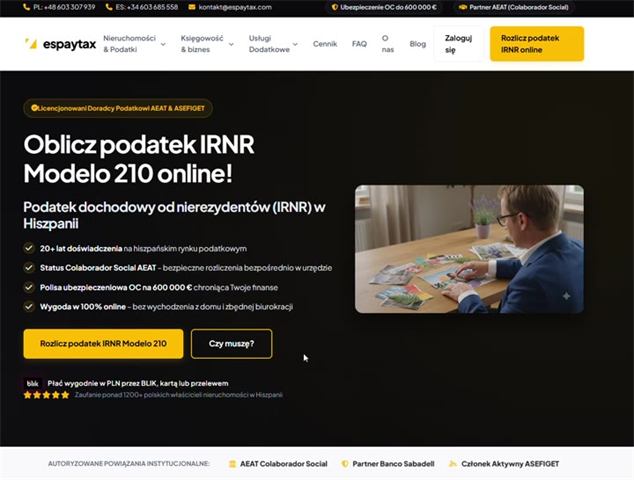
Calculate IRNR Modelo 210 tax online!
Non-resident income tax (IRNR) in Spain
- 20+ years of experience on the Spanish tax market
- AEAT Social Collaborator status – safe filings directly at the office
- Third party liability insurance policy for €600,000 protecting your finances
- Convenience of 100% online – without leaving home and unnecessary bureaucracy
- Support in Polish and Spanish
 Pay easily: BLIK, card, transfer, Google Pay, Apple Pay

How it works? File IRNR in 3 steps
Simple and quick - the whole thing will take you less than 10 minutes.
Create an account
⏱ 1 minGo to the panel and create a free account.
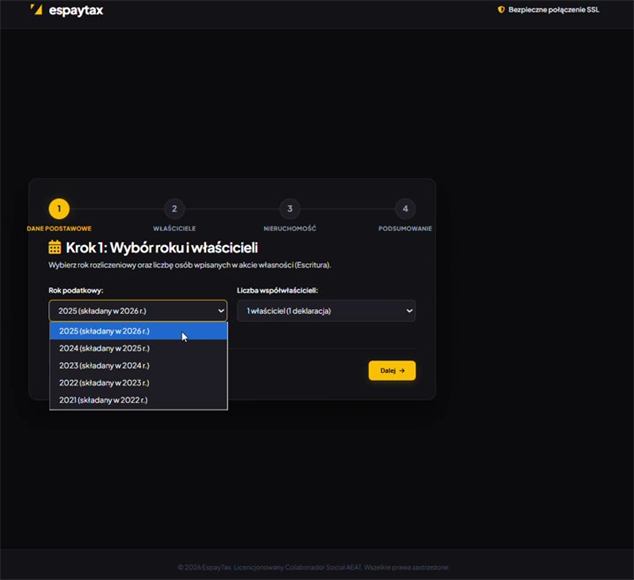
Fill out the form
⏱ 4–5 minA few questions about your property.
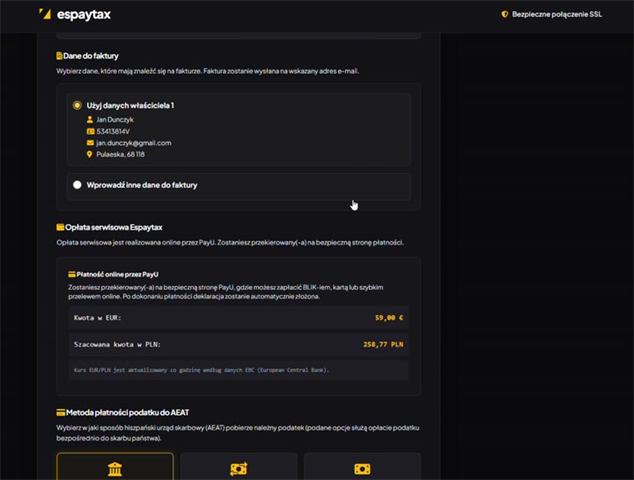
Pay via PayU
⏱ 2 min
BLIK, card or transfer. We will take care of the rest.
Transparent prices
 We accept BLIK payments
IRNR 210 for garage/parking
Tax filing Modelo 210 intended for owners of separate parking spaces/garages.
- Quick cadastral verification
- BLIK payment / transfer in PLN / EUR
- Verification by a tax advisor
IRNR 210 Own use - not rented
Standard Modelo 210 filing for properties not used or intended for own holiday purposes.
- Fulfillment within 72 hours online
- Verification by a tax advisor
- Full support in Polish
IRNR 210 Rental income
Tax returns with deductions for operating expenses and depreciation.
- Maximize your expense deductions
- Safe tax optimization
- AEAT electronic certificate with CSV code
Don't miss our promotions!
Discount coupons, referral program and special offers for our customers.
When is the IRNR Modelo 210 deadline?
Any non-resident who owns property in Spain is subject to non-resident income tax (IRNR). The declaration method depends on how the property is used:
Tax on income from rental property in Spain
If you rent your apartment in Spain (tourist or long-term rental), you are obliged to declare your income.
- Who: Owners renting property.
- Rate: 19% for EU residents (deductible costs), 24% for non-EU residents.
- Deadline: Annual filing for 2026 – until April 20, 2027.
Tax on unused property (imputed income)
If the property is intended for your own use (empty, used as a holiday home), you must pay tax on imputed income once a year (renta imputada).
- Who: All foreign owners of empty premises.
- Rate: 19% of the base (1.1% or 2% of the cadastral value).
- Deadline: Once a year, by December 31 for the previous year.
Capital gains tax
The sale of real estate in Spain by a non-resident involves the obligation to pay capital gains tax.
- Who: Non-residents who have sold real estate.
- Rate: 19% of the actual net profit obtained.
- Retention 3%: The buyer keeps 3% of the price. We help you recover the overpayment if the tax was lower.
Are you required to settle IRNR tax?
Use our interactive calculator to check your liabilities and calculate your tax amount.
IRNR – non-resident property tax in Spain
Find out all about Spanish tax rules for non-resident property owners.
If you own a house or other real estate in Spain (you own real estate, i.e. an apartment, a bungalow, a garage, etc. in Spain) and at the same time you are not a tax resident in Spain (i.e. you do not stay there for 183 days in a calendar year and you live permanently in another country, e.g. Poland), then, according to Spanish tax regulations, you are subject to fiscal legislation for non-residents. This means specific tax liabilities towards the Spanish tax office - Agencia Tributaria (AEAT).
The basic tax is IRNR (Spanish: Impuesto sobre la Renta de no Residentes). This is income tax for non-Spanish residents. Every owner of real estate located in Spain is obliged to settle it, both if it is used exclusively for their own use and when they receive income. Therefore, it can be concluded that the IRNR tax must be settled before the Spanish tax office only due to the fact of owning real estate.
When does the IRNR obligation arise?
Tax liability exists regardless of whether:
- you rent a property and receive rent (both for the entire or just a few months in the tax year),
- you do not rent your property, so you do not generate real income,
- you are selling real estate or the real estate is part of a property transaction (e.g. donation).
However, the relationship between the form of use and tax is important for tax purposes.
Property rental tax in Spain
If you earn income from renting out property, IRNR tax is charged on the rent collected from tenants. For residents of the European Union and the European Economic Area, part of the costs can be deducted. These must be expenses directly and inextricably related to the rented property, e.g. repairs, insurance, utility costs, community fees, IBI tax, mortgage interest and other expenses that you are able to prove with your invoice ("factura completa" or "factura ordinaria"). Such an invoice includes, among others: details of the issuer and buyer, your NIF or NIE number, invoice number, date, tax base and tax rate and amount (IVA).
If you have a simplified invoice (factura simplificada), receipt (ticket), receipt (recibo) or note (note), you cannot include them in the costs reducing the tax Impuesto sobre la Renta de no Residentes. The condition for taking costs into account is also the correct submission of documents and their correct completion (data accuracy is important).
You submit property rental declarations:
- once a year - by January 20 of the following calendar year; or
- quarterly - until the 20th day of April, July, October and January.
Residents from outside the EU/EEA, even if they have a factura completa / factura ordinaria, cannot include them in their costs. As Poles, we have the privilege of membership in the European community.
Tax on imputed income (renta imputada)
You may be surprised by the fact that you have to settle IRNR tax even if your apartment, house or garage is empty all year round. There is a concept in the Spanish tax system "imputada annuity", i.e. "imputed income" or "imputed income". It is calculated based on the cadastral value of the property (Spanish: valor catastral).
The tax base is 2% or 1.1% of the cadastral value of the property (the lower tax rate applies only if the cadastral value of the property has changed in the last 10 years). From the basis calculated in this way, 19% or 24% is calculated. As Polish citizens belong to the EU/EEA, a 19% rate applies.
Form Modelo 210 for IRNR annuity tax must be submitted by the last day of the following calendar year. For 2025, the declaration must be submitted by December 31, 2026. For income for 2026, the deadline starts on April 1 and ends on December 31 of the following year (for 2026 - from April 1 to December 31, 2027).
Capital gains tax
A non-resident is also obliged to settle IRNR tax when trading in real estate. So, when you sell real estate, the so-called capital gains tax. The tax base is then the difference between the sales price and the purchase price (including costs and expenses).
Such a transaction takes into account the so-called retention, i.e. a tax advance in the amount of 3% of the property price. The buyer is obliged to keep this part of the price as an advance payment for the seller's tax and pay it within 4 months of finalizing the transaction. If the selling price is lower than the purchase price, the seller may receive a refund of the overpayment. In this case, he must submit the appropriate form to the AEAT.
Please remember that for the sale of real estate to be carried out in accordance with applicable law, a notary must participate in the process. It will also be necessary to have a tax advance payment and other documentation, i.e.:
- Notarial deed of purchase and sale (escritura)
- Confirmation of IBI tax payment and no arrears
- Documents confirming costs increasing the purchase value (e.g. renovations)
- Evidence of fees and taxes paid on the purchase and sale of real estate
- NO number
- Confirmation of submission of the Modelo 211 declaration by the buyer
The classic real estate sale procedure usually goes as follows:
- When selling real estate, the buyer withholds a 3% advance payment on capital gain tax obtained from the transfer of value;
- The buyer transfers the withheld amount of the advance payment to the tax office, completing the Modelo 211 application, within one month from the date of sale of the property;
- The seller settles the tax on the Modelo 210 form, taking into account 3% withheld by the buyer, and the difference between the purchase value and the sales price of the property is taxed.
Modelo 210 form - IRNR filing
The IRNR tax is settled using the Modelo 210 form, often incorrectly called "model 210" or "modelo". No non-resident can avoid filing a tax return.
When should I submit my tax return using the Modelo 210 form?
- in the case of rental - after the end of the quarter or once a year (from 2025, AEAT gave the opportunity to submit 1 joint annual declaration for the rental period instead of 4 quarterly declarations);
- in the case of imputed income (renta imputada) - by the end of the next calendar year;
- in the event of sale or donation of real estate - up to four months from the finalization of the transaction.
In what form should the Modelo 210 declaration be completed?
The Modelo 210 form can be submitted in two forms: electronically or in paper form (both forms are only available in Spanish).
If you file the declaration yourself, the electronic version requires one of the following forms of authentication:
- electronic certificate (certificado digital)
- Cl@ve (electronic profile)
- intermediary: a tax representative or Colaborador Social AEAT who submits the declaration on behalf of the taxpayer.
If you use Espaytax, you do not need any electronic certificate or Cl@ve profile. The declaration is submitted and signed on your behalf by our licensed intermediary - Colaborador Social de la AEAT.
Who assembles the Modelo 210?
If you are an independent property owner in Spain, you submit the Modelo 210 form for each property separately. If the apartment is on a separate notarial deed, the storage room has a separate notarial deed, and the parking space has a separate notarial deed, you submit at least 3 declarations a year.
In the case of joint ownership (e.g. with the participation of a spouse or a person in a civil partnership), each owner is obliged to submit a separate declaration.
Help with filing IRNR (Modelo 210) online
The language barrier, lack of knowledge of Spanish tax regulations, failure to meet the required deadlines or the number of declarations are just a few of the many problems that non-residents face in Spain. To avoid them, it is worth taking advantage of the opportunities offered by professional assistance in settling the IRNR tax from a Polish-speaking accounting office in Spain - espaytax.
We have liability insurance in the amount of EUR 600,000. We are a member of the Spanish organization ASEFIGET (Asociación Española de Asesores Fiscales y Gestores Tributarios) and registered Colaborador Social AEAT. This allows us to submit tax returns, including Modelo 210 online, on behalf of clients to the Spanish tax office.
The support of our accountants and licensed tax advisors (license no. 0945/1224V) ensures that the filing of the IRNR tax (Modelo 210) will be carried out in accordance with Spanish law, will be free of formal errors and will take place within the statutory deadlines. For our clients, it is a guarantee of avoiding penalties and tax sanctions.
Interactive IRNR tax calculator
If you own property in Spain and you are not a tax resident there, you must pay tax on unused property (renta imputada) or settle rental income once a year.
Use the calculator to estimate your tax amount. Our services are 100% online - you save time and travel costs. Additionally, you can pay conveniently with us via Polish BLIK system!
Help with filing IRNR (Modelo 210) online
We make tax formalities easier. Read the reviews of Polish clients who used our tax filing services in Spain.
Fast and stress-free
"I bought an apartment in Alicante and I had absolutely no idea how to settle Modelo 210. I found EspayTax, the calculator calculated the amount, I uploaded the IBI invoice and after 3 days I had a confirmation from the office. I highly recommend it, no stress and in Polish!"
Professional approach and costs
"I commissioned EspayTax to settle the tax on the rental of my apartment in Malaga. Very professional approach, they deducted all allowable costs (IBI, air conditioning renovation, insurance), thanks to which the tax was minimal."
Dedicated business support
"My husband and I run a Spanish S.L. company dealing with imports. Accounting in Spain can be extremely complicated, but thanks to EspayTax we have everything under control. Our dedicated Polish accountant explains all the complexities to us."
Credibility and effectiveness
"I recommend cooperation with ESPAYTAX. I have personally used the IRNR filing through this consulting office, so I can confirm its reliability and effectiveness. Next year I will definitely use the tax filing on profits from short-term rental. A professional team, nice contact in Polish, commitment and professionalism are just some of the advantages."
Help in a difficult situation
"Very professional, experienced, nice. He helped us in a difficult situation perfectly. I recommend it."
easy, fast and in Polish
"Mega professional service. I settled the Spanish IRNR tax, easily, quickly, entirely in Polish and with Blik. The application on the website guides you through the entire process of the modelo 210 form. I highly recommend it!"
The price matches the quality
"The price is right for the high quality of services."
100% professionalism
"I definitely recommend it! Cooperation with Mr. Luis in opening a business in Spain was truly hassle-free. Everything was carried out efficiently, professionally and, above all, with great attention to detail. At every stage I could count on a quick response and specific solutions. I really appreciate the individual approach and care for the client. 100% professionalism from beginning to end."
A customer for several years
"I am satisfied with the company's services, it has been settling my taxes for several years. Very good and quick contact, professional service, I recommend it."
Modelo 210 form – IRNR tax return
IRNR tax in Spain is filed with the Modelo 210 form (commonly called "model 210" or "modelo"). No non-resident filing should be missed. Below are the most frequently asked questions and answers.
For tax on unused real estate (renta imputada), the declaration for a given year is filed and paid at any point during the following calendar year (e.g. for 2025 the declaration must be submitted by December 31, 2026). For income for 2026, the deadline starts on April 1 and ends on December 31 of the following year (for 2026 - from April 1 to December 31, 2027). For rental income, the filing is submitted for quarterly periods (up to the 20th day of April, July, October and January); from income for 2026, in the case of joint filing, the deadline is April 1-20 of the following year. In the case of sale of real estate, the declaration must be submitted within 4 months from the date of sale.
The declaration can be completed entirely electronically or in paper form (both forms are only available in Spanish). If you are making a declaration alone, you need one of the forms of authentication: electronic certificate (certificado digital) or Cl@ve profile. If you use Espaytax, you do not need any certificate or Cl@ve — the declaration is submitted and signed on your behalf by a licensed intermediary (Colaborador Social de la AEAT).
Any natural person who owns property in Spain and is not tax resident there. If you are an independent owner, you submit the form for each property separately (e.g. if an apartment, storage room and garage have separate deeds, you submit at least 3 declarations). In the case of joint ownership (e.g. married couple), each owner must submit a separate declaration in proportion to his or her share in the property.
As a resident of the EU/EEA (e.g. Poland), you have the right to deduct expenses directly related to renting, such as: community fees (comunidad), IBI tax, utilities (water, electricity, gas), mortgage interest, insurance, advertising costs and depreciation (3% of the building value). A necessary condition is to have a full invoice (factura completa or factura ordinaria) containing your details and NIF/NIE. Receipts, simplified invoices or notes are not accepted by Agencia Tributaria (AEAT).
This is an income tax charged by the Spanish tax office due to the mere fact of owning a property, even if it is empty and used solely for your own use. The tax base is 1.1% (if the cadastral value has been updated within the last 10 years) or 2% of the cadastral value of the property (valor catastral). From this base, Polish residents pay tax at a rate of 19%.
When selling real estate by a non-resident, the buyer has a statutory obligation to retain 3% of the sales price as an advance payment (retention) and pay it to the tax office on form Modelo 211 within a month. The seller must then file a Modelo 210 return within 4 months of the sale to settle capital gains tax. If the tax on the actual profit (the difference between the purchase and sales price after deducting costs) is lower than the 3% retention, the seller has the right to request a refund of the overpaid retention.
File your tax online as a non-resident in Spain
Gain complete security and peace of mind. Avoid complicated official forms in Spanish. Settle Modelo 210 quickly with the help of certified advisors and pay conveniently with BLIK.
File IRNR tax onlineDiscuss your case with us
Do you have questions about taxes, real estate or business in Spain? Our Polish-Spanish team of advisors will analyze your situation and indicate optimal solutions.
Free tax consultation
Book a free 20-minute call or video meeting with our advisor to discuss your needs.
Book an online consultationHeadquarters Poland (Warsaw)
ul. Puławska 228, lok. 38, 02-670 Warsaw, Poland
Headquarters Spain (Valencia)
Calle Frígola 16, 1.º 3.ª, 46980 Paterna (Valencia)